
In this article · 11 sections
- Phutphute Waterfall Quick Facts
- Where Is Phutphute Waterfall?
- How to Get to Phutphute Waterfall
- What Makes Phutphute Waterfall Special
- Best Time to Visit Phutphute Waterfall
- Photo Tips for Phutphute Waterfall
- Safety at the Waterfall
- Can You Visit Phutphute Waterfall as a Day Hike?
- Do Not Confuse It with Narchyang Waterfall
- What Comes After Phutphute Waterfall?
- FAQs About Phutphute Waterfall
At a glance
- Best time to visit
- September–November and March–May
- Duration
- About 2 hours' walk from Humkhola
- Difficulty
- Easy to moderate
- Max altitude
- Around 3,100 m (near Guransedanda, 3,140 m)
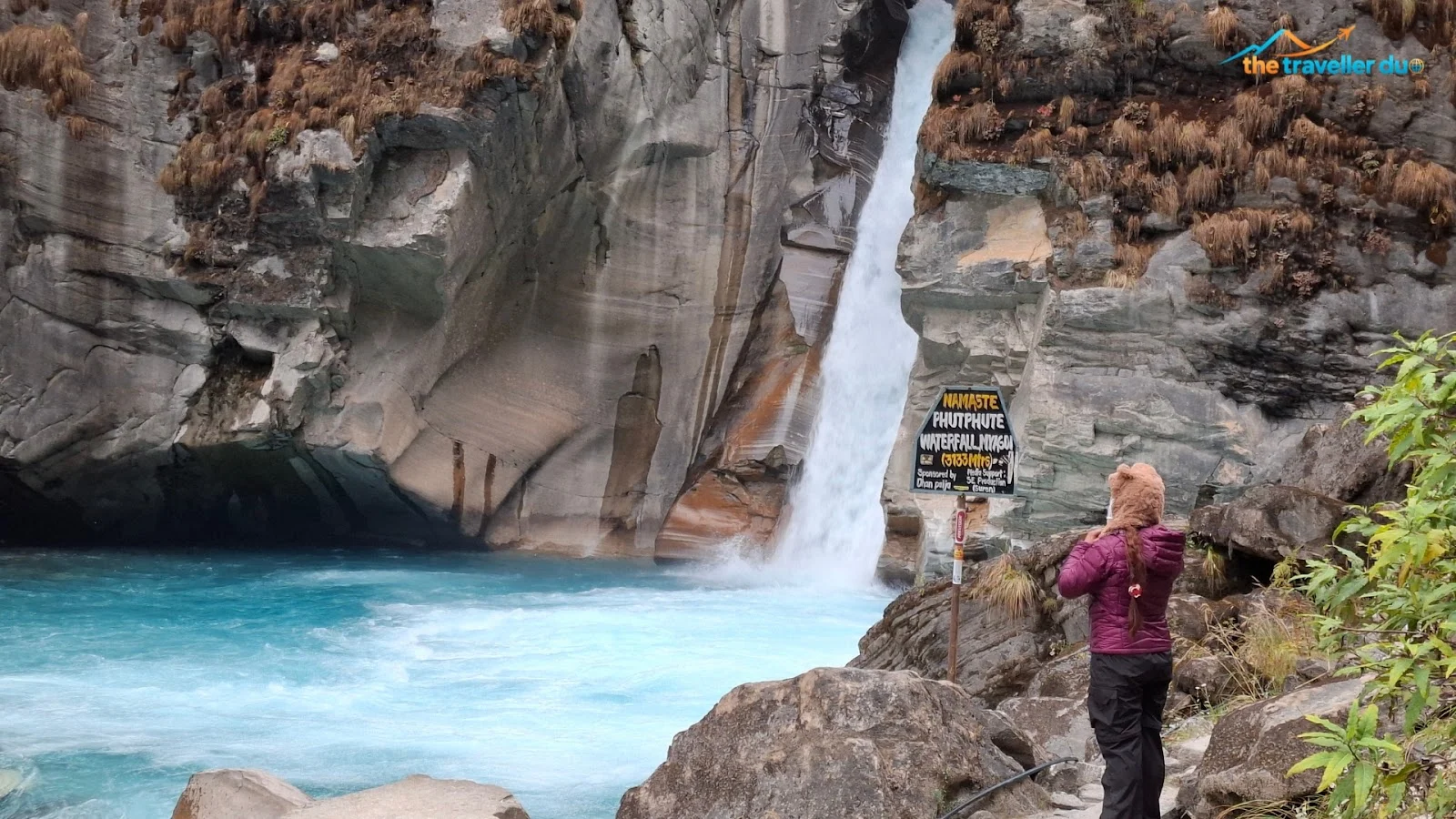
Some waterfalls you look at. Phutphute Waterfall you feel. The roar hits you before you see it. Then the trail turns a corner and a white column of water crashes into a pool so blue it looks painted.
It was the first stop on my North ABC Trek, about two hours after we left Humkhola. Locals call it Futfute Jharna or Phutphute Jharana. Whatever you call it, it is one of the best rewards on the whole trail. Here is how to get there and how to make the most of it.
Phutphute Waterfall Quick Facts
| Detail | Information |
|---|---|
| Other names | Futfute Jharna, Phutphute Jharana, Futfute Waterfall |
| Location | Maurice Herzog Trail above Humkhola, Narchyang, Annapurna Rural Municipality-4, Myagdi |
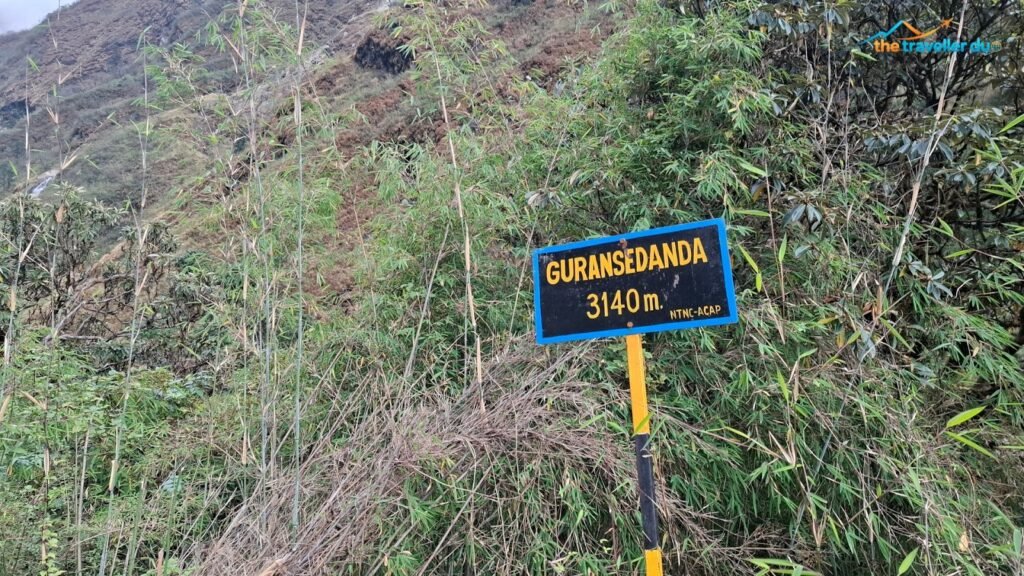
| Nearest landmark | Guransedanda signboard (3,140 m) |
| Starting point | Humkhola (about 2,840 m) |
| Walking time | About 2 hours from Humkhola |
| River | The glacier-fed Mistri Khola |
| Next stop | Sandhikharka, 30 to 45 minutes uphill |
| Permit | Inside the Annapurna Conservation Area |
| Best time | September to November, and March to May |
Where Is Phutphute Waterfall?
Phutphute Waterfall sits in the Mistri Khola valley in Myagdi district, western Nepal. It is on the Maurice Herzog Trail, the route to North Annapurna Base Camp, close to a place called Guransedanda (also written Gurase Danda).
There is no road to the waterfall. You have to walk. The good news is that it is only about two hours from Humkhola, where the jeep track ends.
How to Get to Phutphute Waterfall
Step 1: Reach Humkhola
From Pokhara, take a Jomsom-bound bus to Tatopani in Myagdi. We paid NPR 800 per person and left at 6 AM. From Tatopani, hire a Bolero jeep to Humkhola. The jeep costs about NPR 8,000 for the whole vehicle, so share it with other trekkers.
The full step-by-step is in my guide on how to reach Humkhola.
Step 2: Walk from Humkhola
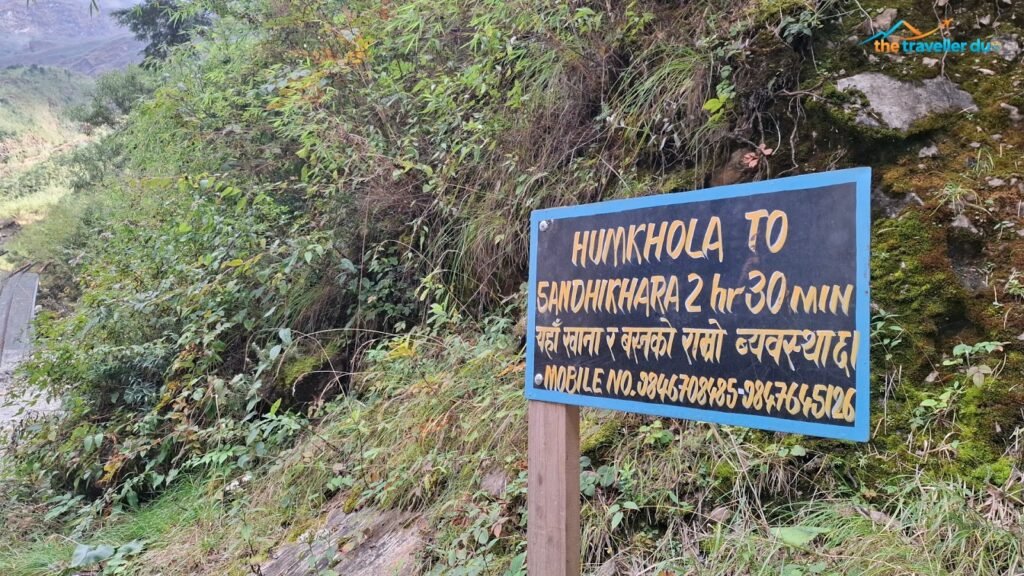
Right above Humkhola, a signboard says Sandhikharka is 2 hours 30 minutes away. Phutphute Waterfall is on the way.
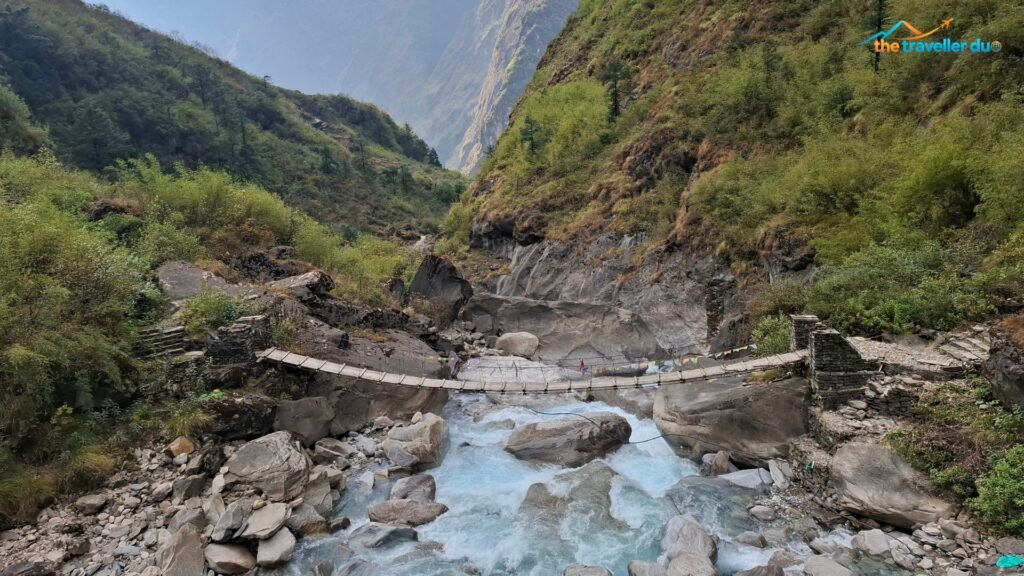
The trail follows the river through forest and bamboo. You cross wooden suspension bridges over water that is glacier blue. A new suspension bridge has also been built over the Hum Khola in recent years. It is a steady climb, but nothing technical.
We started walking from Humkhola at about 3:30 PM and still had plenty of daylight to enjoy the waterfall before moving on.
What Makes Phutphute Waterfall Special
The water does not just fall. It explodes out of a narrow cut in the rock and pours into a deep turquoise pool. Smooth grey cliffs curve around it like the walls of a bowl.
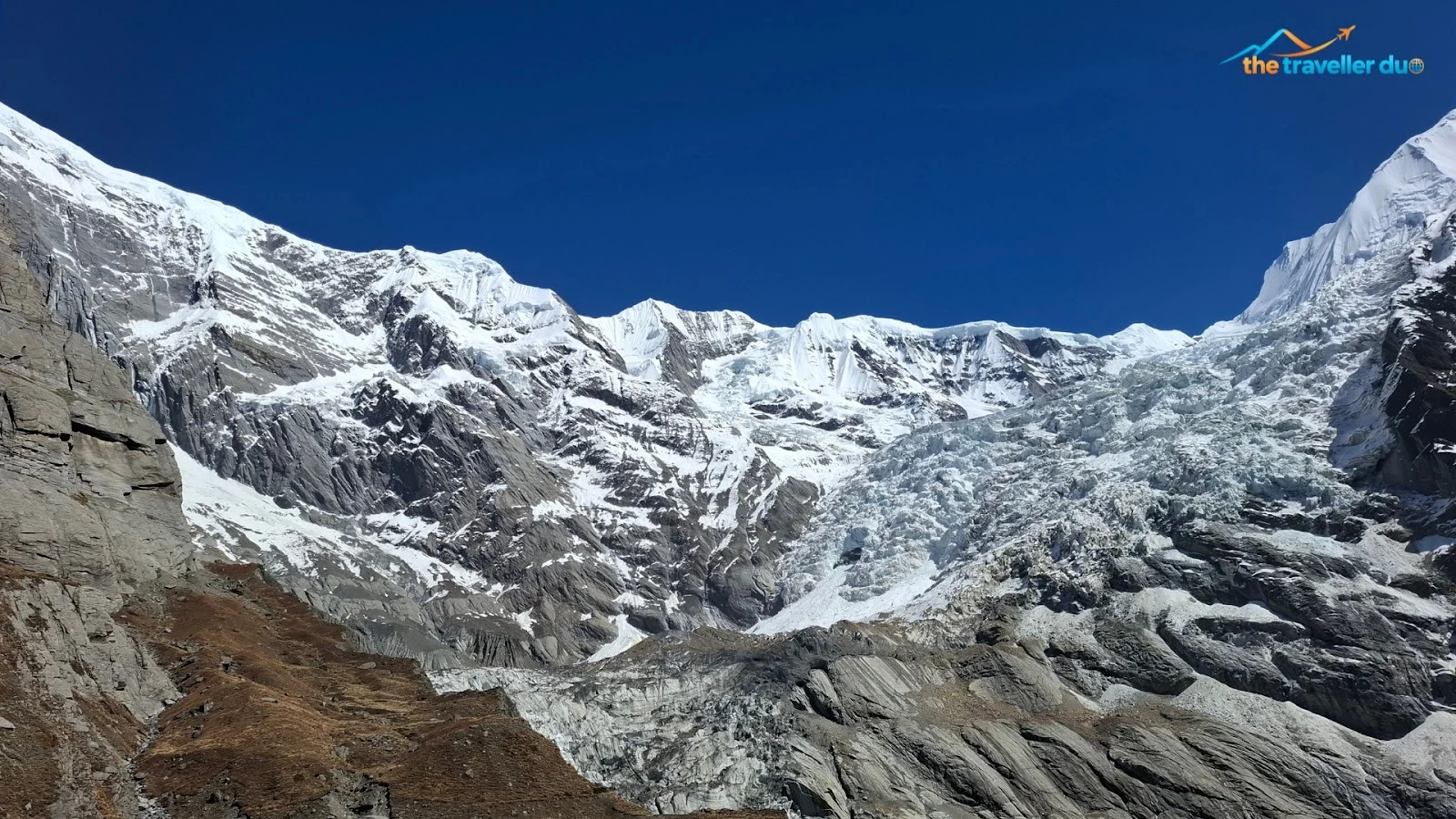
The color comes from the glacier. The Mistri Khola carries meltwater from the Annapurna range, and the fine rock dust in it turns the water an unreal shade of blue.
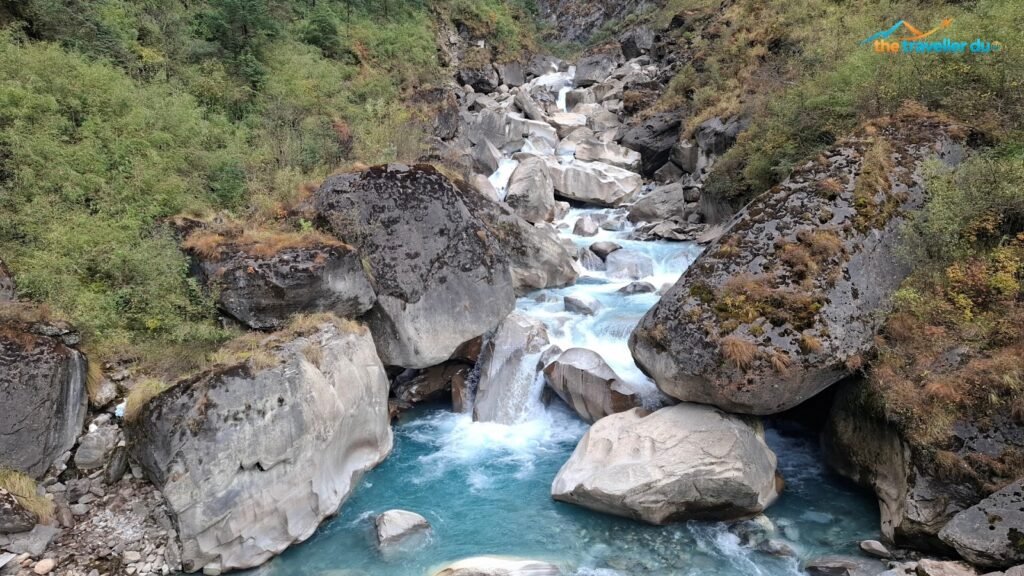
Close by there is a wooden suspension bridge, and another tall waterfall drops from the cliffs nearby. It is the kind of place where you plan to stop for five minutes and stay for thirty.
Best Time to Visit Phutphute Waterfall
- September to November: clear skies, strong water flow after the monsoon and the best light for photos. This is my top pick.
- March to May: stable weather and green forest. The flow is a little lower.
- June to August: the waterfall is at its biggest, but trails are slippery, leeches are out and landslides can close the road from Tatopani.
- December to February: less water, cold mornings and quiet trails.
Photo Tips for Phutphute Waterfall
- Go in the morning or late afternoon for softer light on the cliffs.
- Put a person in the frame. Without one, it is hard to show how big the fall is.
- Try your phone’s long exposure or night mode for that silky water look.
- Keep a cloth handy. The spray reaches further than you think.
- Stay off wet rocks near the edge. One slip is all it takes.
Safety at the Waterfall
The pool looks inviting, but do not swim. The water is ice cold and the current is strong. Rocks near the fall are always wet and slippery. During the monsoon, water levels can rise fast after rain higher up. Keep children close and stay on the main trail.
Can You Visit Phutphute Waterfall as a Day Hike?
Yes. If you are staying at Humkhola or nearby, you can walk up to the waterfall in about 2 hours and come back down in about 1.5 hours. It makes a great short hike for anyone who wants a taste of the trail without going all the way to the base camp.
Most people, though, visit it on the first day of the North ABC Trek and carry on to Sandhikharka or Gufaphant for the night. See my guide on where to stay on the North ABC Trek.
Do Not Confuse It with Narchyang Waterfall
There is another famous waterfall in the same area. Narchyang Waterfall is near Tatopani, on the Kali Gandaki side, and is a short hike from Tatopani village. It is a tall, thin fall on the cliffs above the Annapurna Circuit road.
Phutphute Waterfall is a different place. It is deeper in the Mistri Khola valley, on the trail to North Annapurna Base Camp, and you can only reach it from Humkhola on foot.
What Comes After Phutphute Waterfall?
From the waterfall, the trail climbs for 30 to 45 minutes to Sandhikharka, the first homestay on the route. Above that comes Gufaphant at 3,319 m, where we spent the night. The next morning we walked on to Panchakunda Lake and the base camp.
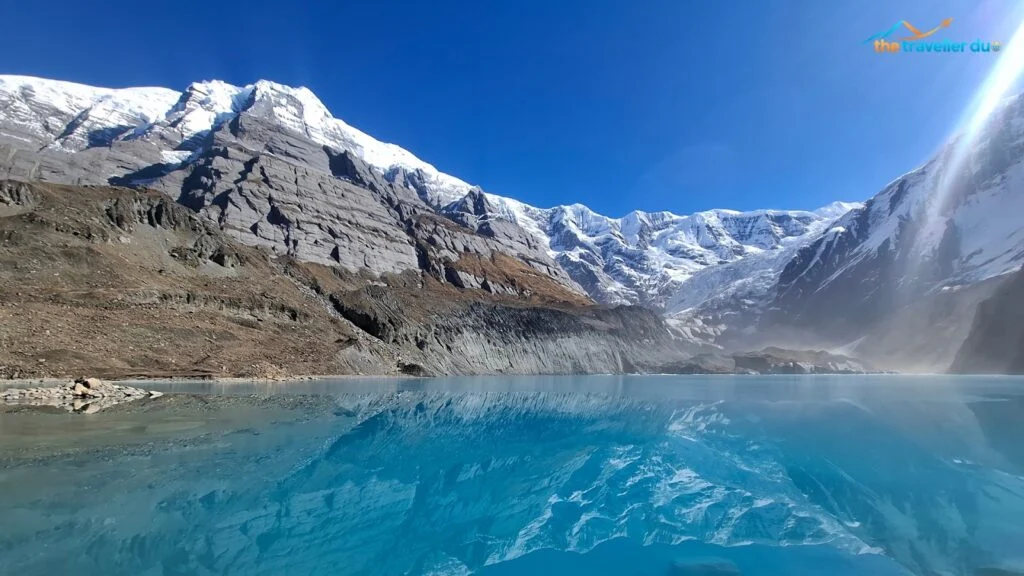
If you have time, do not stop at the waterfall. The best is still ahead.
FAQs About Phutphute Waterfall
Where is Phutphute Waterfall?
Phutphute Waterfall (Futfute Jharna) is on the Maurice Herzog Trail in the Mistri Khola valley, Narchyang, Myagdi district. It is about 2 hours’ walk above Humkhola.
How do you get to Phutphute Waterfall?
Take a bus from Pokhara to Tatopani, a Bolero jeep from Tatopani to Humkhola, then walk about 2 hours up the trail toward Sandhikharka.
Is Futfute Jharna the same as Phutphute Waterfall?
Yes. Futfute Jharna, Phutphute Jharana and Phutphute Waterfall are different spellings of the same waterfall.
Is Phutphute Waterfall the same as Narchyang Waterfall?
No. Narchyang Waterfall is near Tatopani on the Kali Gandaki side. Phutphute Waterfall is above Humkhola on the North ABC trail.
Can I swim at Phutphute Waterfall?
It is not safe. The glacier-fed water is extremely cold, the current is strong and the rocks are slippery.
What is the best time to visit Phutphute Waterfall?
September to November is best, with good water flow and clear skies. March to May is also good.
Where can I stay near Phutphute Waterfall?
Sandhikharka, the first homestay on the route, is 30 to 45 minutes above the waterfall. Gufaphant is about 2 hours further.